We believe all turfgrass managers are interested in maximizing the efficacy of their fungicide applications. In fact, many superintendents have asked how various post application management practices, such as post-application irrigation and mowing timing, influence fungicide movement and efficacy. With the cost of fungicides increasing 10-20% over the past decade, turfgrass managers are trying to maximize efficacy of fungicides. Recent research out of Dr. Travis Gannon's lab has demonstrated up to 34% of azoxystrobin can be removed in tall fescue clippings following a single mowing event one day after the initial application (Jeffries et al., 2016). Removal of this much fungicide is a waste of money and may limit the amount of product being delivered to the target pest. However, there is limited research evaluating the effect of post-application management practices on fungicide environmental fate and movement on golf course putting greens. The current study evaluated post-application irrigation timing and mowing timing on the distribution of fungicides in the soil profile and the removal of fungicides in turfgrass clippings.
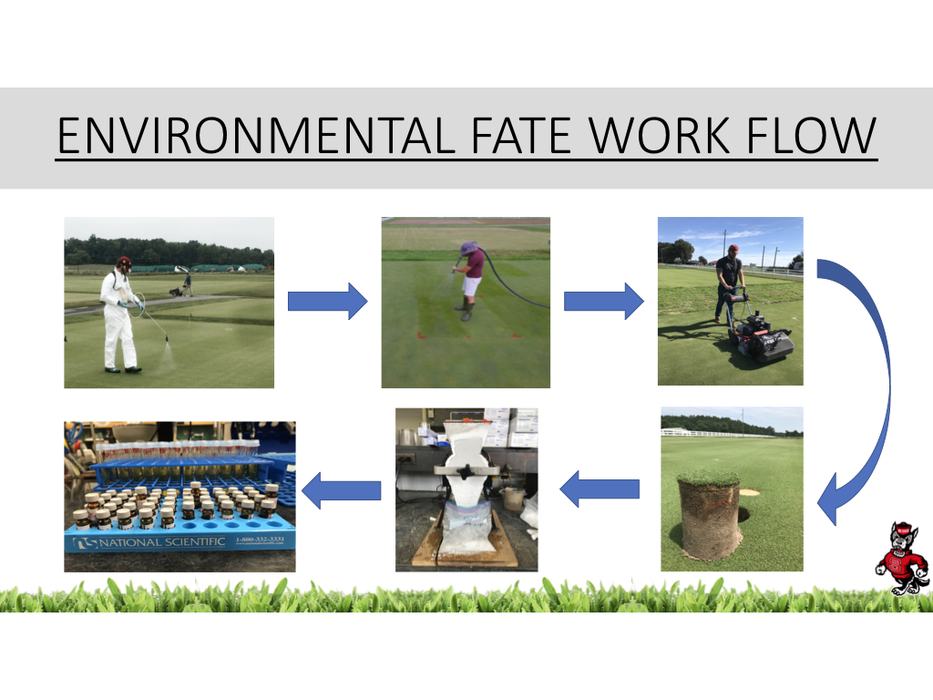
A single application of pyraclostrobin and triadimefon was applied independently to research plots on a creeping bentgrass putting green. Irrigation (1/4”) was applied either immediately (0h) or 6 hours (6h) after the fungicide application. Plots were mowed non-sequentially once the canopy was dry at 0 days after treatment (DAT), 1 DAT, and 3 DAT following respective fungicide applications and irrigation treatments. Daily mowing resumed after 3 DAT. Clippings were collected at 0, 1, and 3 DAT and cores (4.25” diameter) were harvested using a golf course cup cutter 0, 1, 3, 5, 7, 14 DAT. Cores were sectioned into remaining above ground vegetation (RAV; verdure/thatch), 0-1”, 1-2”, and 2-3” subsections. Turfgrass clippings and core subsections were subjected to residue analysis using high-performance liquid chromatography and data was presented as a percent of applied.
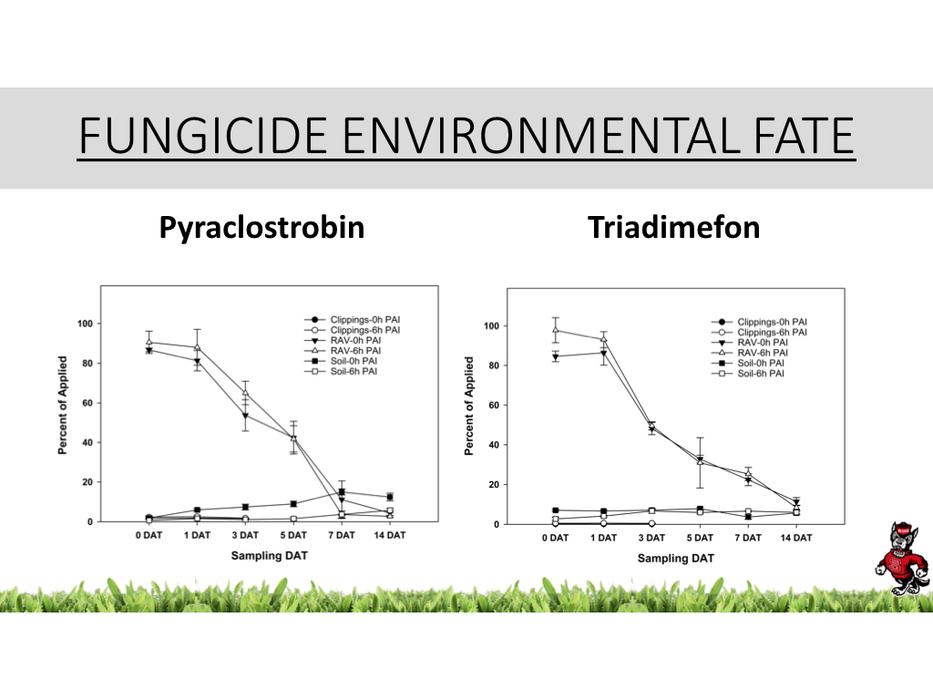
Pyraclostrobin recovered in turfgrass clippings at 0, 1, and 3 DAT did not exceed 2.5% of total fungicide applied. The movement and distribution of pyraclostrobin over time following different irrigation and mowing treatments is illustrated in Figure 1. Post application irrigation (PAI) timing and mowing timing did not significantly influence the percent of pyraclostrobin removed in turfgrass clippings. Within sampling days, post-application irrigation timing did not significantly influence the percent of pyraclostrobin detected in the RAV. However, differences were observed in soil subsections over the course of the experiment. For example, more pyraclostrobin was detected in the 0-1” soil layer when plots were irrigated immediately with 1/4” of irrigation. Similarly, at 3, 5, and 7 DAT, pyraclostrobin was only detected in plots receiving immediate irrigation. In the 0-1” soil layer at 14 DAT a significantly greater amount of pyraclostrobin was detected in plots receiving immediate irrigation compared to plots irrigated 6 hours after fungicide application.