

Purple Bermudagrass Greens? Cold Weather Likely to Blame
go.ncsu.edu/readext?1106438
en Español / em Português
El inglés es el idioma de control de esta página. En la medida en que haya algún conflicto entre la traducción al inglés y la traducción, el inglés prevalece.
Al hacer clic en el enlace de traducción se activa un servicio de traducción gratuito para convertir la página al español. Al igual que con cualquier traducción por Internet, la conversión no es sensible al contexto y puede que no traduzca el texto en su significado original. NC State Extension no garantiza la exactitud del texto traducido. Por favor, tenga en cuenta que algunas aplicaciones y/o servicios pueden no funcionar como se espera cuando se traducen.
Português
Inglês é o idioma de controle desta página. Na medida que haja algum conflito entre o texto original em Inglês e a tradução, o Inglês prevalece.
Ao clicar no link de tradução, um serviço gratuito de tradução será ativado para converter a página para o Português. Como em qualquer tradução pela internet, a conversão não é sensivel ao contexto e pode não ocorrer a tradução para o significado orginal. O serviço de Extensão da Carolina do Norte (NC State Extension) não garante a exatidão do texto traduzido. Por favor, observe que algumas funções ou serviços podem não funcionar como esperado após a tradução.
English
English is the controlling language of this page. To the extent there is any conflict between the English text and the translation, English controls.
Clicking on the translation link activates a free translation service to convert the page to Spanish. As with any Internet translation, the conversion is not context-sensitive and may not translate the text to its original meaning. NC State Extension does not guarantee the accuracy of the translated text. Please note that some applications and/or services may not function as expected when translated.
Collapse ▲This fall, the weather has been ideal for golf and mainly for reducing pathogen activity. Signs of mini-ring and take-all root rot are appearing on bermudagrass putting greens, but the pathogens were more active when soil temperatures were higher and during rainfall in summer and early fall. Currently, most of North Carolina is abnormally dry or in a moderate drought. Fungal pathogens respond to temperature and moisture, and although the temperatures have been suitable, the moisture levels have not. If a disease is present, it is probably due to poor infiltration from irrigation cycles or overwatering.
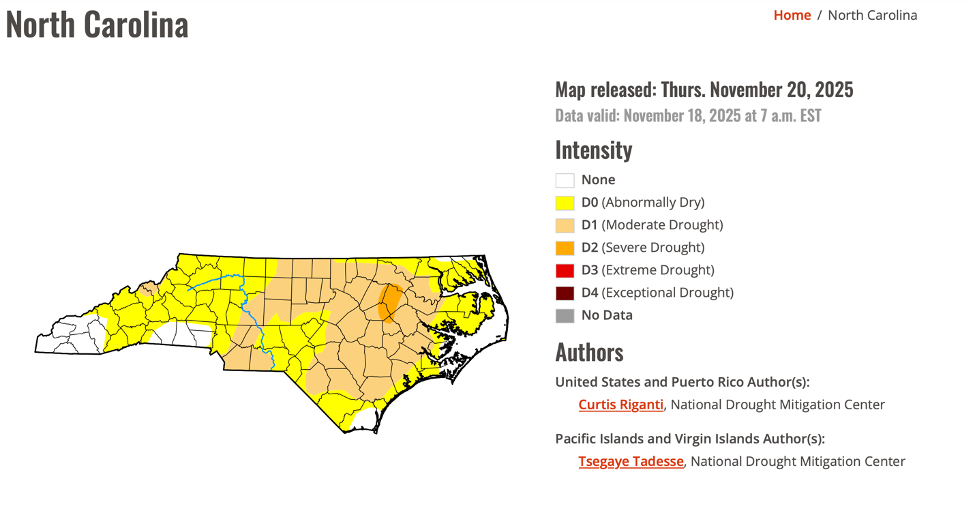
North Carolina drought intensity as of November 20th, 2025. Note that most of NC has been abnormally dry or in moderate drought. This would not support fungal activity. https://droughtmonitor.unl.edu/CurrentMap/StateDroughtMonitor.aspx?NC
Additionally, the pathogen may have been active earlier this year and bypassed fungicide treatments, or there may have been gaps in the fungicide program. Unfortunately, not much can be done right now if mini-ring and take-all root rot have developed. It is important to monitor leaf spot and Pythium blight on ultradwarf bermudagrass putting greens. Under persistent cloudy, wet weather, QoIs or phosphite applications will not effectively control Pythium blight. If those conditions are forecast, use a product specifically designed for Pythium, such as Subdue MAXX, Banol, Serata, or Segway.

Images illustrating cold injury or chloroplast masking on the stand and leaf tip. An image of leaf spot is also included to highlight the differences. Note that the leaf spot symptoms are sunken, while cold injury appears as discoloration.
The upcoming forecast for NC doesn’t currently favor leaf spot or Pythium blight, but it does indicate chloroplast masking. We call this chloroplast evacuation, which happens when turfgrass plants stop producing chlorophyll as light levels decrease, revealing other pigments, such as anthocyanin (the purple pigment in plants). With the forecasted cold nights, bermudagrass putting greens are likely to develop purple spots that may resemble a disease. However, if you examine the leaf tips, you’ll see they are purple; unlike leaves affected by leaf spot or Pythium blight, where the whole leaf shows damage. Based on the forecast, we wouldn’t expect much leaf spot or Pythium blight activity, but we do expect purpling caused by the cold temperatures. If you suspect a disease is present, please feel free to reach out.